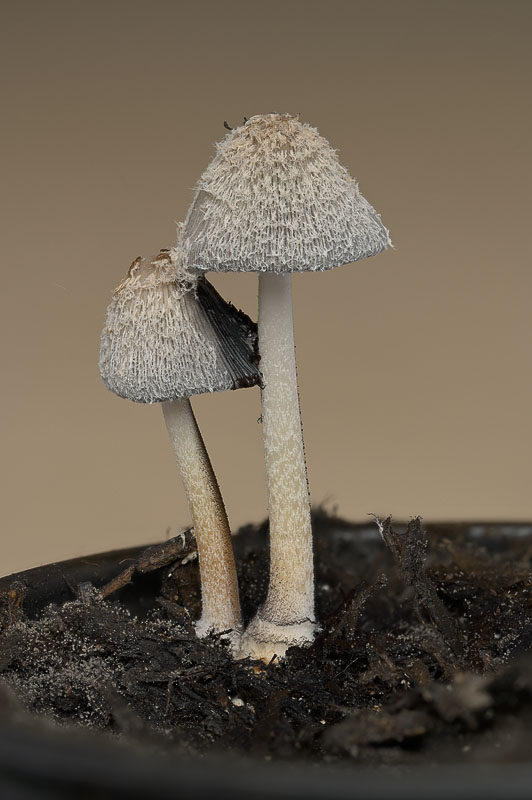
On composted straw and horse manure. 14 February 2025 Four Marks, Hampshire. Photograph copyright Leif Goodwin. Cap Initially egg shaped, cuticle greyish, densely covered with soft whitish scales, expanding with age, greyish to grey brown, radially furrowed, deliquescing from the margin, about 1 to 4 cm across Gills Crowded, free, narrow, whitish then black Stem Cylindrical, often broader at the base, scaly, whitish, often yellowish brown at the base Flesh Thin, soft, white Smell Indistinct Taste Unknown Season Spring to autumn Distribution Common Habitat On dung, mixed straw and manure, and compost Spore Print Black Microscopic Features Spores ellipsoidal to ovoid, smooth (8.5-12) x (6-8) µm2. Gill cystidia broadly ellipsoidal. Veil consisting of long chains of sausage like elements. Edibility Inedible Notes The specimens shown were growing in pots of composted horse dung and straw that were being used for germinating chilli and tomato seeds. 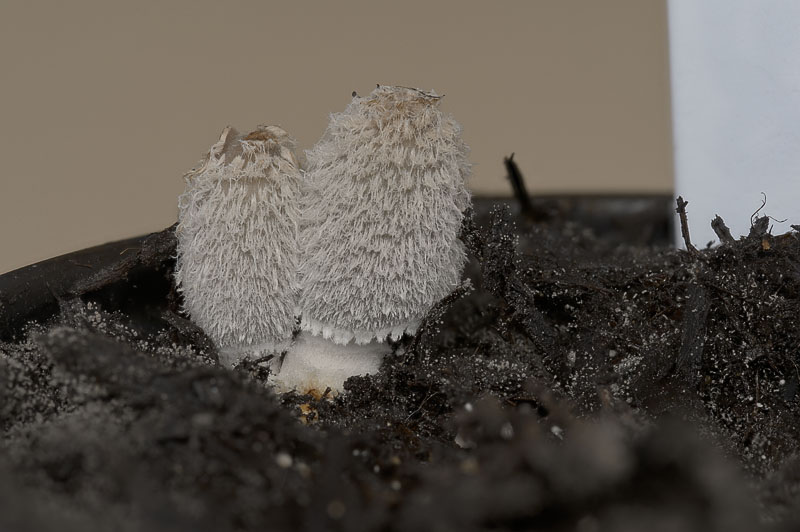
14 February 2025 Four Marks, Hampshire. Photograph copyright Leif Goodwin. 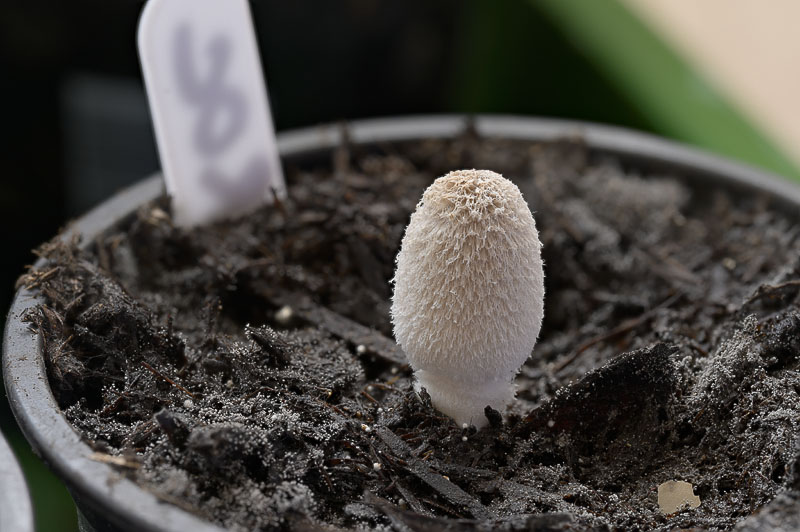
14 February 2025 Four Marks, Hampshire. Photograph copyright Leif Goodwin. 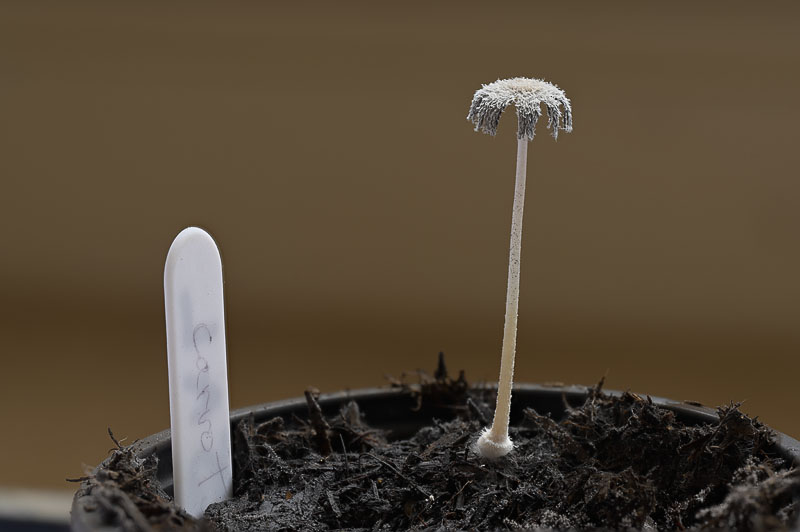
14 February 2025 Four Marks, Hampshire. Photograph copyright Leif Goodwin. 
Spores in Congo Red solution viewed with a 100X immersion objective. 14 February 2025 Four Marks, Hampshire. Photograph copyright Leif Goodwin. 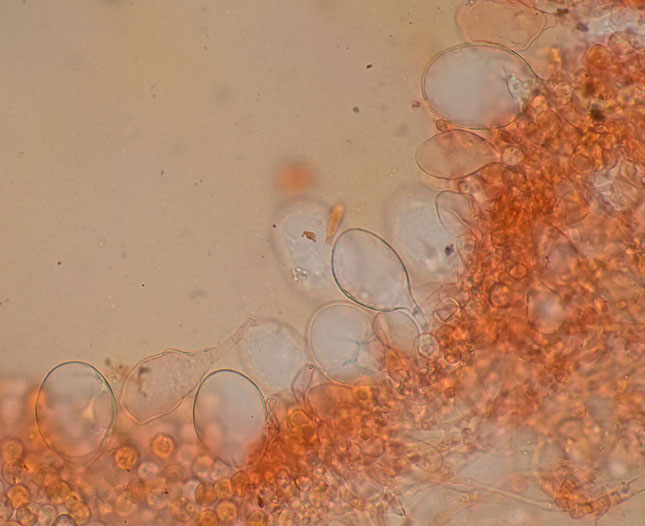
Gill cystidia in Congo Red solution viewed with a 40X objective. 14 February 2025 Four Marks, Hampshire. Photograph copyright Leif Goodwin. 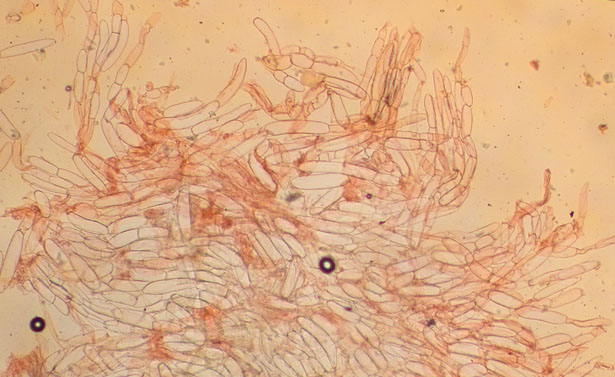
Cap veil cells in Congo Red solution viewed with a 10X objective. 14 February 2025 Four Marks, Hampshire. Photograph copyright Leif Goodwin. |